

Is Boxing Good for Weight Loss? What the Science Actually Says

Short answer: yes, boxing is excellent for weight loss. But the reasons why are more interesting than most fitness content lets on. This post breaks down the actual science — so you can understand what's happening in your body during a boxing class, and why it tends to outperform traditional gym cardio for sustained fat loss.
How Many Calories Does Boxing Burn?
A 60-minute boxing session burns between 400 and 700 calories, depending on your body weight, intensity, and class format. That puts it on par with running — but with far higher muscle engagement and a much lower impact on your joints.
Our Sweat Science HIIT class sits at the higher end of that range. It combines boxing-inspired intervals with strength movements, keeping your heart rate elevated throughout. If calorie burn is your primary goal, this class is your best option on our schedule.
Full-Body Engagement: Why Boxing Burns More Than It Looks
When you throw a punch, you're not just using your arms. A properly thrown jab starts from your feet, travels through your legs, rotates through your hips and core, and exits through your shoulder and fist. Every major muscle group is involved.
Compare that to a treadmill run, where you're primarily using your lower body in a repetitive, linear pattern. Boxing creates a more complex neuromuscular demand, which means your body works harder to execute and recover from each movement.
Add defensive movements — slipping, rolling, footwork — and you're essentially performing full-body athletic work for an hour straight.
EPOC: The Reason You Keep Burning After Class
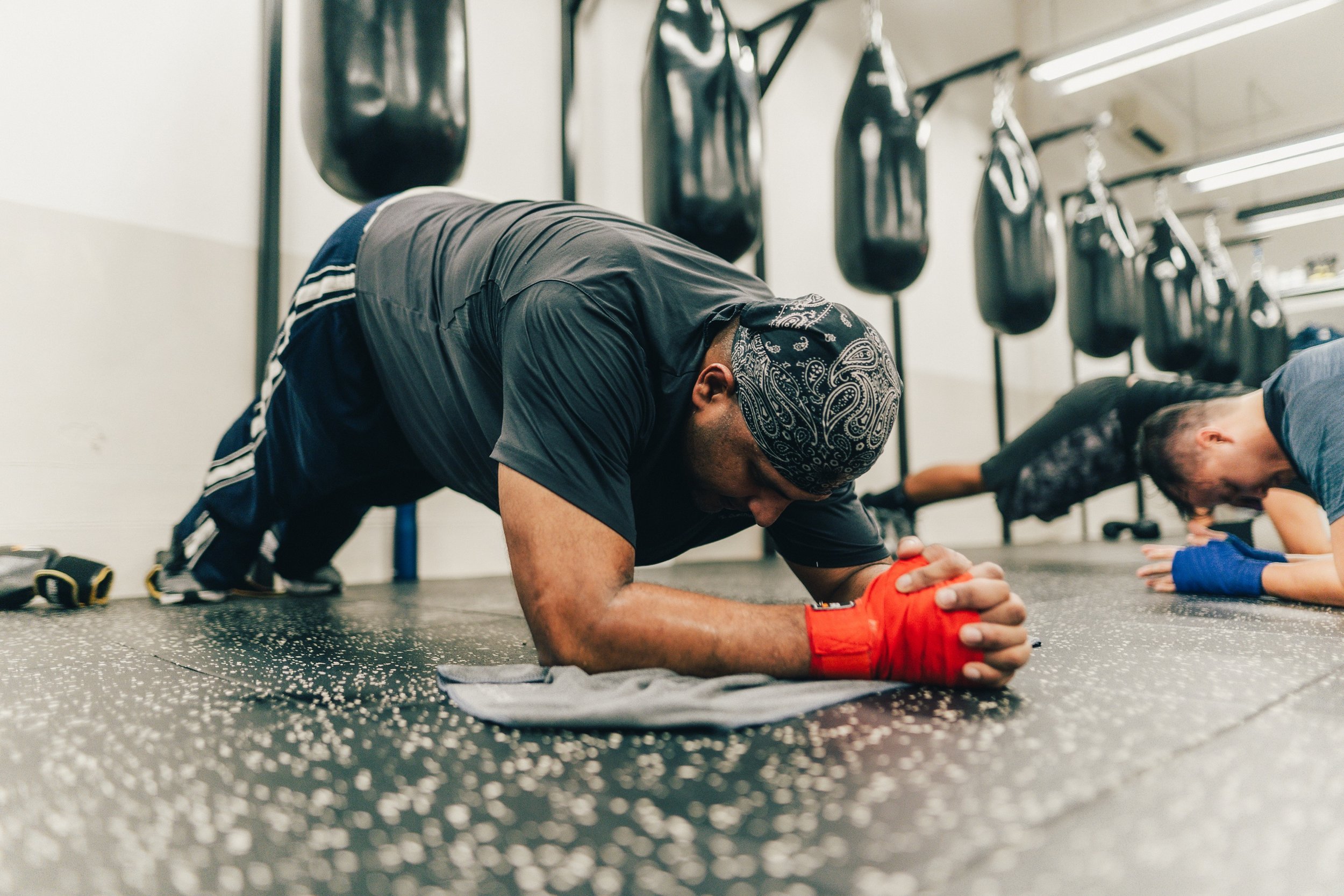
EPOC stands for Excess Post-exercise Oxygen Consumption. It's the phenomenon where your body continues burning calories at an elevated rate after a high-intensity workout — not just during it.
High-intensity interval training (HIIT) and complex skill-based exercise like boxing produce significantly higher EPOC than steady-state cardio. Studies suggest this elevated burn can continue for 24–48 hours after a sufficiently intense session.
In practical terms: a boxing class doesn't just burn calories for the hour you're in the gym. It keeps burning for the rest of the day.
Boxing vs Running vs Traditional HIIT: An Honest Comparison
Running is effective, but it's repetitive, high-impact, and — for many people — genuinely boring. Adherence is the biggest predictor of weight loss results, and people who hate their workouts don't stick to them.
Traditional gym HIIT classes can be effective, but they often lack skill development. You're repeating the same burpee-squat-jump pattern every session, which gets easier as you adapt and eventually stops producing the same results.
Boxing solves both problems. It's demanding enough to produce strong EPOC, varied enough to stay interesting, and skill-based enough that you're always improving — which means your body can't fully adapt and plateau in the same way.
How We Track Your Progress
Weight on a scale is a misleading metric. It doesn't distinguish between fat, muscle, and water. Someone could lose 3kg of fat and gain 1.5kg of muscle and think they've 'only lost 1.5kg' when in reality their body composition has dramatically improved.
That's why every new member at Sweat Science Studio gets a complimentary Body Composition Analysis. In under two minutes, you get your baseline: body fat percentage, muscle mass, visceral fat, and hydration levels. We retest periodically so you can see exactly what's changing — not just your weight, but what that weight is made of.
What Real Progress Looks Like
Most members who train 2–3 times per week notice visible changes within 6–8 weeks. The first thing most people report is not a number on a scale — it's that their clothes fit differently, they have more energy, and they're sleeping better.
Fat loss from boxing is gradual and sustainable. It's not a crash diet. It's a consistent weekly calorie burn combined with improved muscle tone that compounds over time.
