

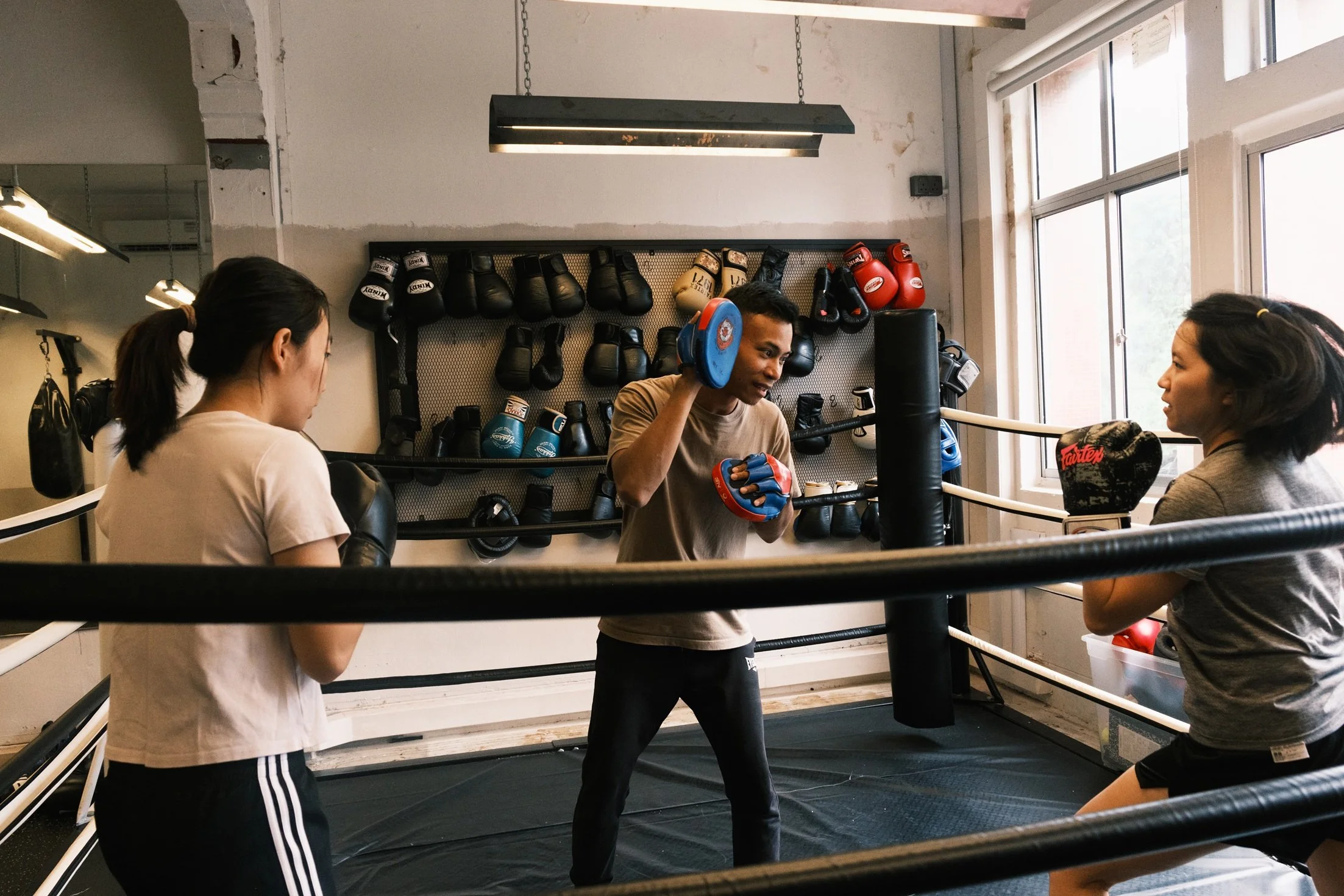
Singapore adults under 50 need at least 0.8 g of protein per kg of body weight per day, according to the Health Promotion Board (HPB). Adults who train three or more times a week do better at 1.4 to 2.0 g per kg.
This guide turns those ratios into grams, shows the numbers for three body weights, and explains how to split the total across the day. We are boxing coaches, not dietitians, so every figure comes from HPB or the International Society of Sports Nutrition (ISSN).
The official baseline
HPB recommends 0.8 g per kg per day for adults aged 18 to 49 and 1.2 g per kg for adults 50 and above. HealthHub, HPB's public site, puts the typical figure for a younger adult at about 50 to 60 g a day. A 65 kg adult under 50 works out to 52 g (0.8 × 65).
These numbers are minimums for general health. They do not account for training.
Why training raises the number
ISSN's position is that people who exercise regularly need more protein than 0.8 g per kg, whatever the type of exercise. Its ranges depend on the activity: 1.0 to 1.6 g per kg for endurance training, 1.4 to 1.7 g per kg for intermittent activity, and 1.6 to 2.0 g per kg for strength and power training. Boxing classes alternate hard bursts with short rests, which makes them intermittent.
Your daily target in grams
Grams per kg of body weight per day, with totals for 60 kg, 75 kg and 90 kg.
Adult under 50, not training (HPB): 0.8 g/kg
60 kg: 48 g
75 kg: 60 g
90 kg: 72 g
Adult 50 or older (HPB): 1.2 g/kg
60 kg: 72 g
75 kg: 90 g
90 kg: 108 g
Boxing classes, 3 to 4 a week (ISSN, intermittent): 1.4–1.7 g/kg
60 kg: 84–102 g
75 kg: 105–128 g
90 kg: 126–153 g
Boxing plus weights, 3 a week (ISSN, strength): 1.6–2.0 g/kg
60 kg: 96–120 g
75 kg: 120–150 g
90 kg: 144–180 g
Fat loss while training: 1.6–2.2 g/kg
60 kg: 96–132 g
75 kg: 120–165 g
90 kg: 144–198 g
HPB = Health Promotion Board. ISSN = International Society of Sports Nutrition.
If you carry a lot of excess body fat, base the calculation on a healthy target weight and confirm the figure with a dietitian. If you are 50 or older and train, use the exercise range and treat the 50-and-above HPB figure as your floor.
Pick your number in three steps
1. Choose the row that matches how you train.
2. Multiply the g-per-kg figure by your body weight in kg.
3. Start at the low end of the range. A 49-trial meta-analysis found that muscle gains from resistance training flatten out around 1.6 g per kg per day, so there is little reason to start at the top.
Split it across the day
Research on single meals puts the muscle-building response close to its ceiling at about 0.3 to 0.4 g of protein per kg per meal. That is 18 to 24 g for a 60 kg member, 23 to 30 g for 75 kg and 27 to 36 g for 90 kg. Reach the daily total first. The split is a refinement.
Example (illustration, not a member case): a 75 kg member training with boxing and weights aims for 120 g. One workable day is 30 g at breakfast, 35 g at lunch, 15 g as a snack and 40 g at dinner.
What 20 to 40 g looks like
Approximate protein per food:
Meat (beef, lamb, chicken, pork): about 25 g per 100 g (HPB database average)
Seafood, including fish: about 23 g per 100 g (HPB database average)
Nuts: about 21 g per 100 g (HPB database average)
Eggs: about 12 g per 100 g, or roughly 6 g per egg
Firm tofu: about 12–15 g per 100 g
For real hawker numbers, see High-Protein Hawker and Food Court Meals in Singapore
When more does not help
Above roughly 1.6 g per kg, extra protein adds little muscle for people doing resistance training, and the upper end of the research sits near 2.2 g per kg. Beyond that, the extra protein adds cost and calories. ISSN's position is that 1.4 to 2.0 g per kg is not detrimental to kidney function or bone health in healthy, active people.
Who should get personal advice
See a doctor or registered dietitian before changing your protein intake if you have kidney disease or reduced kidney function, are pregnant or breastfeeding, are under 18, have a history of disordered eating, or are managing a medical condition through diet.
Practical Information
Protein supports muscle only when training gives it a reason. Sweat Science Studio runs group classes and private 1-on-1 sessions at Clarke Quay, with showers and changing rooms on site. First class is free.
Location: 42C North Canal Road, Level 4, Singapore 059298. A short walk from Clarke Quay MRT.
